CAC Annual Filing in Nigeria
Everything you need to know about CAC annual returns explained in simple language
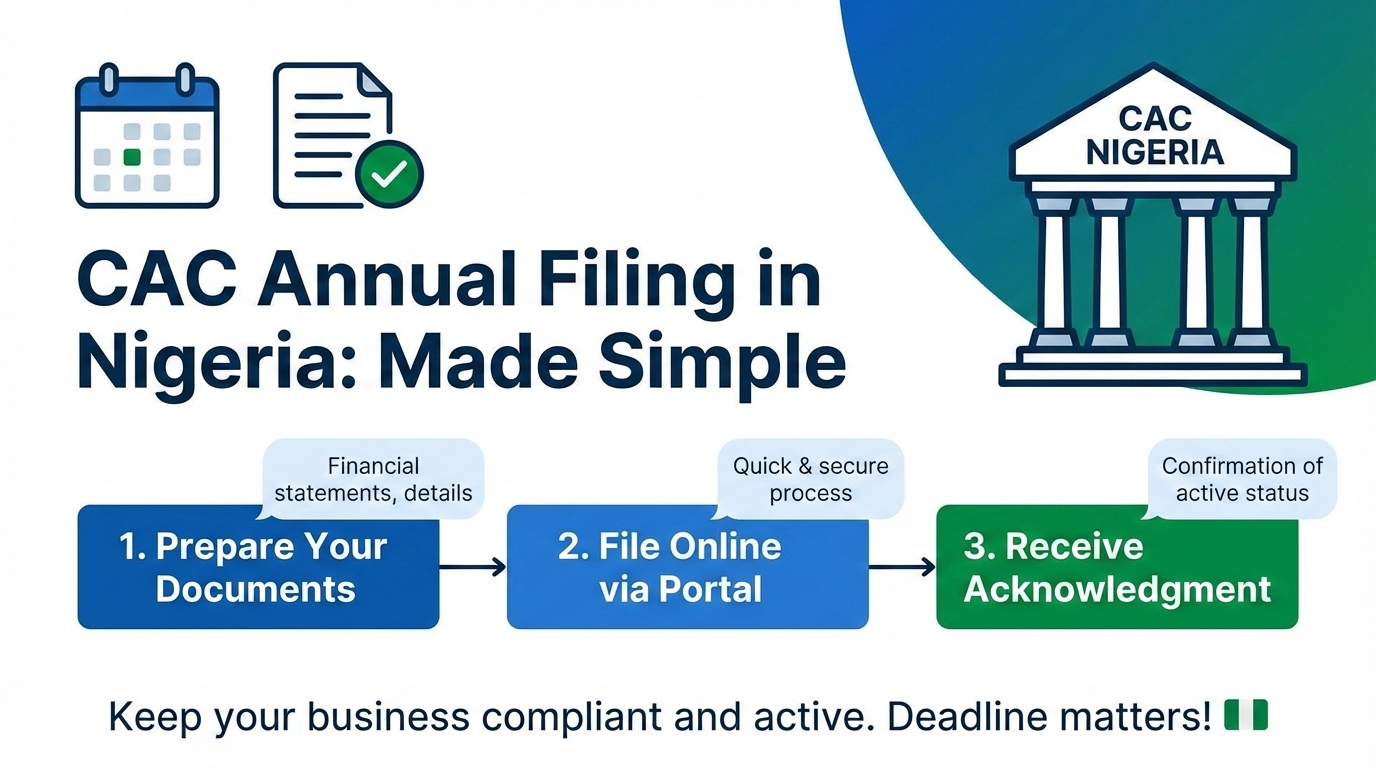
If you registered a business name, limited liability company, or NGO with the Corporate Affairs Commission (CAC), you are legally required to file annual returns.
Unfortunately, many Nigerian business owners either do not know about this requirement or ignore it until penalties start piling up.
This guide breaks everything down in plain English — no legal grammar, no confusion.
What Is CAC Annual Filing?
CAC annual filing (also called annual returns) is a yearly confirmation you submit to CAC to show that your business or organization is still active and operating.
Every year, CAC asks: "Is your business still running? Yes or No?"
Filing annual returns is how you officially answer "YES, we're still in business!"
Who Must File CAC Annual Returns?
- Business Name owners (sole proprietors & partnerships)
- Limited Liability Companies (Ltd)
- Incorporated Trustees (churches, NGOs, associations)
- Companies Limited by Guarantee
- Private and Public Companies
When Do You Start Filing?
📋 Business Name (Sole Proprietorship/Partnership)
You start filing 18 months after registration, then every year after that.
If you registered your business name in January 2023,
Your first annual return will be due in July 2024.
Subsequent filings are due every July thereafter.
🏢 Limited Liability Company (Ltd)
Companies start filing 18 months after incorporation, then yearly thereafter.
What Happens If You Don't File?
- Financial Penalties: Late fees accumulate for every year you miss
- Inactive Status: Your business may show as "Inactive" on CAC records
- Banking Issues: Problems opening or maintaining corporate bank accounts
- Funding Barriers: Issues when applying for grants, loans, or investor funding
- Contract Limitations: Difficulty securing government or large corporate contracts
Common Scenarios Explained
Scenario 1: "My business is not active right now"
CAC does not consider operational status. If the business is registered and not formally closed, you must continue filing annual returns.
Scenario 2: "I just registered my business last year"
If it has not reached 18 months since registration, you don't need to file yet. Mark your calendar for the 18-month anniversary.
Scenario 3: "I forgot to file for several years"
You can still file, but you will need to pay penalties for each missed year. It's better to regularize now than to keep delaying.
Why You Should File Early
- Avoid Penalties: Late filing attracts unnecessary fees
- Maintain Active Status: Your business stays "Active" on CAC records
- Business Credibility: Shows professionalism to partners and clients
- Banking Access: Smooth transactions with corporate accounts
- Peace of Mind: No last-minute stress or rush fees
How to File CAC Annual Returns
CAC annual returns are filed through accredited agents or directly via the CAC portal. The process typically requires:
- Your RC/BN number (Registration Certificate/Business Name number)
- Updated company information
- Financial statements (for companies)
- Payment of prescribed fees
Frequently Asked Questions
Q: Is CAC annual filing really compulsory?
A: Yes. It's required by law for all registered business entities in Nigeria. Non-compliance can lead to penalties and business status issues.
Q: Can someone file on my behalf?
A: Yes. Many business owners use accredited agents, lawyers, or consultants to handle their annual filings.
Q: What if I want to close my business instead?
A: Business closure is a separate legal process called "striking off." Until the business is formally closed, annual filing remains compulsory.


Final Advice for Business Owners
Stay Compliant. Protect Your Business Reputation. Grow With Confidence.